

I stumbled across an old enterprise architecture maturity model the other day, dating back to 2006. It comes from Jeanne Ross, Peter Weill and David Robertson’s Enterprise Architecture as Strategy. It’s twenty years old, and remarkably relevant to where we find ourselves with AI today. Their model uses four stages to describe a really accessible view of enterprise architecture maturity.
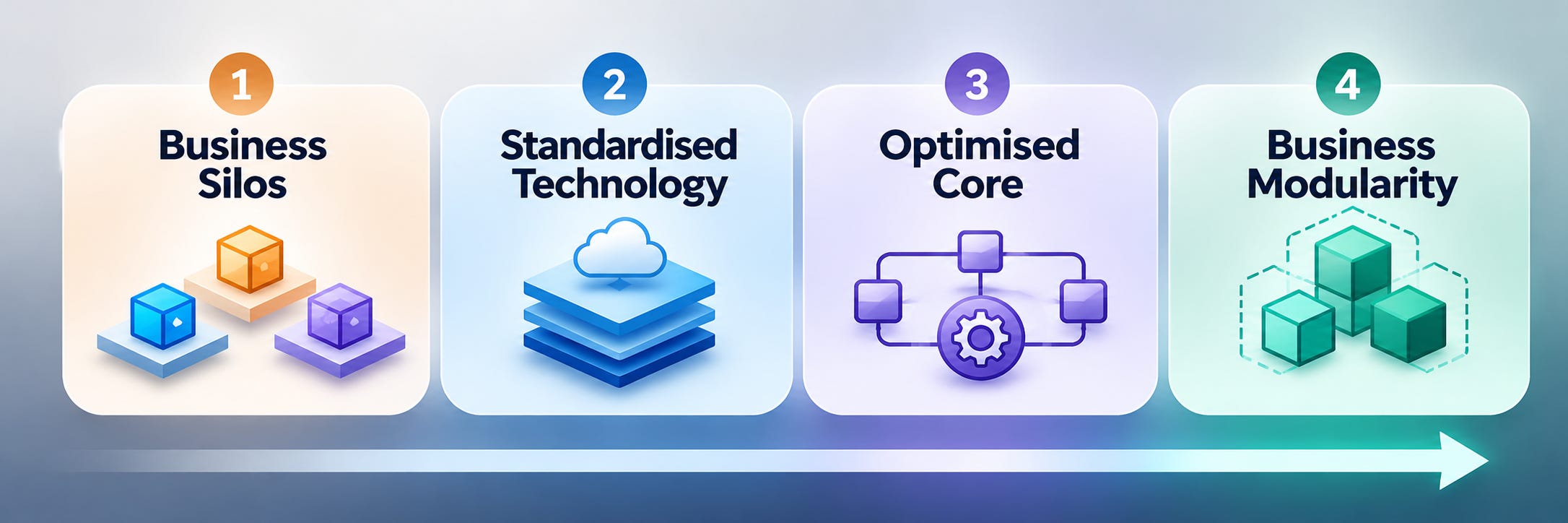
Individual business units develop their own applications and technology capabilities to meet local needs.
Organisations begin consolidating infrastructure, establishing common technical standards and reducing IT costs through shared platforms and services.
The focus shifts from technology to the business itself. Standardising and integrating core enterprise processes and data, improving operational performance, and establishing the management capabilities needed to define and measure how work happens.
Organisations build on that optimised core to create reusable, configurable business process components that can be assembled and adapted as business needs change.
What struck me most was the distinction between stages two and three. On the tail end of decades of modernising, transforming and optimising core technology infrastructure, cloud platforms, application consolidation and technical architectures, we find ourselves at the biggest inflection point in tech history, largely ill-prepared for what comes next.
What Optimised Core meant in this model was an organisations attention to the core processes and data of the business itself. How it works, not simply the technology it runs on. It is such a great term that it is no wonder that somewhere along the way, the language of enterprise transformation became a proxy for technology transformation.
An organisation can have a highly optimised technology environment supporting a business that isn’t particularly optimised at all. Which brings us to this AI moment.
Technology vendors are making extraordinary investments in Enterprise AI Platforms, intelligent agents, orchestration and autonomous execution. The ambition is no longer simply to support the work people do, but increasingly to have intelligent systems coordinate and execute that work themselves. But what work, exactly?
If organisations haven’t adequately optimised their core, what are we asking these increasingly autonomous systems to execute? That extends to re-establishing how decisions are made, where accountability sits, what constitutes a successful outcome, how confident can we be about delegating those decisions to AI.
Perhaps the most interesting thing about revisiting this twenty-year-old model is that it reminds us that enterprise architecture maturity was never simply about technology maturity. Each stage required corresponding changes in a higher-order operating model. AI doesn’t make those requirements disappear. If anything, it makes them considerably more important.
So in thinking about what an Optimised Core means for an agentic enterprise I think we can start by focusing on just three connected terms. Understand how work actually happens. Transform how it should happen. Then establish the conditions under which that redesigned work can be trust(ed) to autonomously execute.
AI isn’t simply taking us into the next stage of enterprise architecture maturity. It’s exposing just how much unfinished business we have from the previous ones. We finally have the technology to execute work autonomously. We just haven’t done enough work on the work itself.
But this isn’t simply about going back and fixing or automating what we already do. The nature of work is changing, and so are the organisations in which that work happens. We’re not just optimising the old enterprise. We’re figuring out how to build a fundamentally different one. That’s where the next big opportunity in enterprise AI sits.
The technology vendors are doing an extraordinary job of building the platforms, intelligence and capabilities. But someone still needs to help organisations understand their work, redesign how it should happen, establish the conditions for trusted autonomy, and make the economics stack up. That’s not simply a technology implementation challenge. It’s business transformation, operating model design and organisational change.
And it’s why I think 2027 could be a big comeback year for service partners in the AI ecosystem. Not because customers need more people to implement AI platforms, but because they need partners who can help them move beyond simply automating the business they have, towards building the business they are becoming.
About Councilio
Councilio provides independent technology analysis, executive briefings, keynote speaking, workshops, and strategic consulting and advisory services.
Learn more: councilio.co