

Soon after ServiceNow’s Knowledge 2026 event, I wrote (here) about a question I kept hearing from customers. How do organisations move from their current mix of solutions and licences towards an agentic enterprise?
The concern was not necessarily about reaching a single, defined endpoint. Most weren’t looking for an architectural do-over just yet. It was more about understanding the practical steps needed to progress along a journey. This year, Servicenow’s vision for that destination has largely been framed through AI Control Tower.
Their agentic blueprint helped make sense of what can sometimes feel like the puzzle box of its rapidly expanding platform. But the customers I spoke with across large enterprises, the mid-market and public sector were all still asking more immediate questions. Like, “ok, but what do I do on Monday?” Or, “what is the next realistic step?”
They just wanted to know how they could connect their existing investments, how Servicenow could help them understand how work is actually happening in their own businesses, and then how to progressively build the capability (on Servicenow) to autonomously execute more of it. And fair enough, too.
The following diagram was, at the time, an early attempt to frame that journey. Its basic premise, shaped by those existing customer conversations, was to begin with a clear point of entry (e.g. ITSM, HRSD or CSM/CRM), and build from there. New customers face a similar question. They need to understand where to enter the platform and where that initial investment can take them. Moveworks, Veza, Flow and the many other additions to the Servicenow portfolio have expanded the possible points of entry. They have also made it more important for them to provide a clear progression story from the first use case to the broader platform vision.
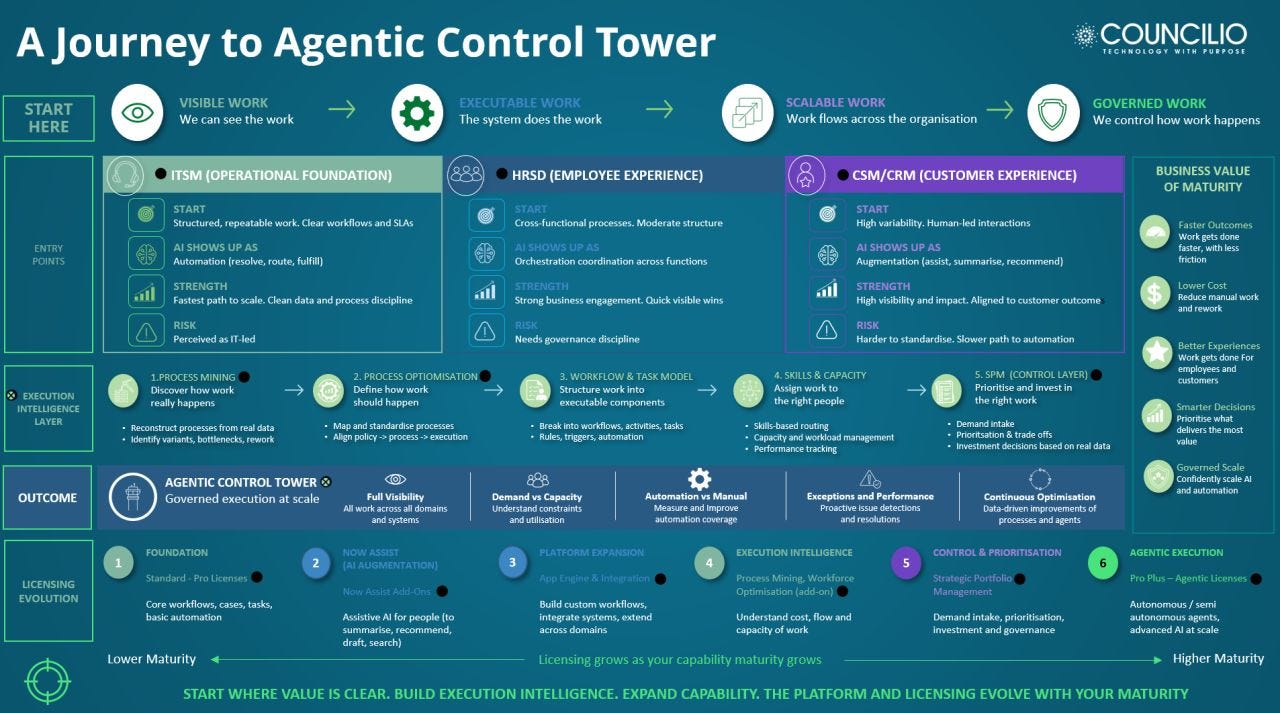
Crucially, for most Servicenow customers, at least at the time of writing, there are several platform capabilities to develop before reaching the north-star vision of an agentic control tower. These include helpful solutions like process mining and optimisation, workflow and task modelling, and skills and capacity management.
Together, these products form what I described in the diagram as the execution intelligence layer. These are the platform capabilities less likely to command the keynote stage, but they are essential to making work visible, executable, scalable and, ultimately, governable.
From my reading of it, Servicenow’s recent AI Workflow Factory announcement provides a clearer and more practical answer to those customer questions. With the above historical context as a baseline, I think its significance lies partly in the way existing platform capabilities have been repackaged into a coherent improvement cycle and enhanced with new AI capabilities such as Autonomous Engineer. That’s the beauty and possibility of PaaS.
The AI Workflow Factory solution brings together capabilities including Process Mining, Autonomous Engineer, Build Agent, App Engine and AI Control Tower as a continuous improvement cycle.
The cycle begins by making existing work visible and decomposing it into its underlying processes, tasks, decisions, exceptions and controls. That understanding can then be used to reconstruct the work as tested and governed workflows that combine human judgement, deterministic automation and AI agents. Those workflows can be progressively deployed, measured and refined as the organisation develops confidence in the outcomes.
This process is essential to trusted automation. Organisations cannot simply place agents over poorly understood work practices and expect reliable results. They must first understand how the work happens, decide how it should happen and then rebuild it in a form that can be executed, governed and ultimately trusted at scale. These are some of the key areas I’m writing about in my new book, Beyond the Bubble.
Autonomous Engineer is particularly important within that cycle because it addresses part of the original customer question. How do we move from the environment we have today to the next practical stage of agentic capability?
Operating like an always-available Servicenow implementation engineer, it can interpret requirements, examine the existing Servicenow environment, develop an implementation plan, build the required workflows and applications, and test them against agreed acceptance criteria. It provides part of the mechanism for moving from an identified opportunity to governed, executable work.
It is also a practical example of why AI is already disrupting the software engineering employment market. Work that once required substantial human effort across requirements analysis, solution design, development and testing can increasingly be completed by an autonomous engineering system, with people retaining responsibility for direction, judgement and approval. That is really why the announcement matters.
The bottleneck in enterprise AI adoption has never been limited to access to a model. After my last trip to San Francisco I can confidently say that just about all industry leaders are agreed on that.
Adoption success ultimately comes down to three things. Understand the work. Transform the work. Trust the work.
Organisations must understand how work happens today, decide how it should change and then demonstrate that the resulting execution is reliable enough to automate and scale.
This helps explain why so many organisations have struggled to move beyond pilots. They may have acquired AI capabilities, but they have not yet developed a repeatable system (that is well governed, or at least risk-minimised), for converting AI opportunity into operational improvement. AI Workflow Factory is Servicenow’s attempt to productise more of the machinery to support that progression.
All that said, a maturity journey and a product offering are different things altogether. That was the point I was making back in May when I said that licensing alone does not unlock capability. It’s actually the opposite. Capability maturity is what ultimately justifies the licensing. And we will see a solution like AIWF succeed or fall on that basis.
As with almost every enterprise software announcement today, there is an economic story here as well. Servicenow’s credit model spans process mining, application users, testing capacity and development environments. My read is that this creates an understandable and auditable commercial structure around an organisation’s capacity to continuously improve their work (i.e. capability maturity). As that improvement cycle expands, so too does consumption of the platform.
This is particularly significant as AI begins to weaken the relationship between software growth and the number of human users. A consumption model gives Servicenow a way to participate economically in the rising volume of work performed by workflows and agents, even where employee numbers remain unchanged.
Most leading enterprise software is now being measured on its ability to convert greater autonomy and machine-executed work into durable revenue growth for the software vendors. So this new solution also gives investors another measure through which to assess whether Servicenow is well positioned to thrive through the AI transition. Spoiler: it is.
For customers, however, the value equation remains unchanged. The productivity and operational gains must exceed the full cost of building, governing and running that capacity. Consumption may align pricing more closely with use, but use alone is not evidence of value.
For me, this announcement is one of the more valuable 2026 developments in Servicenow’s platform story. It is consistent with several of the architectural decisions now emerging from its product teams, and it begins to connect the ambition of autonomous execution with the practical work required to achieve it.
The next challenge is one of translation and execution. Do customers and partners understand the proposition well enough to make this improvement cycle repeatable across the messy realities of their own organisations? I’m not sure but early endorsements from some large regional SIs supporting the announcement suggest the answer is yes.
But there is also an internal go-to-market question for Servicenow. Can its sales teams clearly explain the value of what is essentially the modern equivalent of “middleware” infrastructure beneath the agentic enterprise? It may be less immediately compelling than the flagship AI products competing for headlines, but it provides the progression story customers have been asking for.
It also shows how customers can begin with the capabilities they already have, make work visible, progressively improve and automate it, and then scale that execution under a common governance model.
If Servicenow gets that story right, amidst all the other announcements and products and acquisitions flooding the company this year, AI Workflow Factory should do more than create a new product category or pull through the broader platform. It could give customers the practical and commercially coherent path they’ve been looking for, and allow their Servicenow platform adoption to align and expand as their execution capability matures.
About Councilio
Councilio provides independent technology analysis, executive briefings, keynote speaking, workshops, and strategic consulting and advisory services.
Learn more: councilio.co