

There was no shortage of announcements at Dreamforce this year. Salesforce continued to flesh out its Agentic Enterprise proposition across Data 360, Customer 360, Agentforce and an expanding range of interfaces, including Slack and Claude.
But perhaps what struck me most was just how much clearer the overall architecture has become. Arguably the clearest I have seen it. There is some irony in that. For years, Salesforce has struggled at times to bring its expanding portfolio of clouds, acquisitions and capabilities together into one coherent platform story. Yet it seems to have taken the disruption of agentic AI, and the need to rethink much of its traditional application-centric business, to bring that story into focus.
And perhaps that’s the point. Rather than simply adding AI to its existing portfolio, Salesforce is being “forced” (ha ha) to reconsider how the pieces fit together and what role each plays in the enterprise of the future.
Data 360 provides the context, Customer 360 the business logic and deterministic execution, Agentforce the digital workforce, and increasingly open interfaces the means through which work gets initiated. MuleSoft Agent Fabric, meanwhile, is intended to bring orchestration and governance to an increasingly complex ecosystem of agents, including those operating beyond Salesforce.
Add to that the Agent Context Engine, agent observability and security capabilities, new agentic applications across sales, service and IT, and a more deliberate embrace of frontier models. There is plenty to unpack this year. But one of the more interesting developments for me wasn’t another agent or another interface (as impressive as they were). It was the progress Salesforce is making on the economics of the Agentic Enterprise. And after several conversations at Dreamforce, I came away thinking this deserves more attention than it is getting.
During the week, I had four separate sessions with Salesforce executives focused on pricing and commercial models. What struck me wasn’t that they had all the answers but rather the speed at which they are moving, the resources being committed and the willingness to challenge commercial assumptions that have underpinned enterprise software for decades.
Because Salesforce isn’t simply trying to figure out how to price agents. It’s trying to make sense of an entirely new commercial model for customers, its own sales teams, the people responsible for enabling those teams, and a rapidly changing partner ecosystem. And they’re having to do this while the underlying technology, competitive landscape and customer and market expectations are changing by the week.
In my discussions, their execs were refreshingly pragmatic. The message was essentially that the traditional pricing book no longer works and they are throwing the kitchen sink at working it out. Some customers want per-user pricing. Others want consumption, transactions, resolutions, agent-based arrangements or ultimately business outcomes. And Salesforce is increasingly prepared to accommodate that diversity. Mark Benioff even riffed on it during his keynote wanderings.


Flex Credits, digital wallets, enterprise consumption commitments, outcome-oriented agents and headless platform interaction pricing all point towards a more flexible commercial architecture that recognises that autonomous work cannot always be bought and sold in the same way as traditional enterprise software.
The evolution from charging $2 per conversation a little over a year ago towards more granular action-based pricing, including the ten-cent agent action, is a practical example. So too is the move towards longer-term consumption commitments through arrangements such as Salesforce Commit, where customers can establish a commercial commitment and draw against it as their requirements evolve. It’s a model that starts to look more like the hyperscalers than the traditional enterprise software industry. But the more interesting development is the recognition that there may not be one right commercial model at all.
We are also beginning to see this thinking translate into more recognisable product packaging. One of the Dreamforce keynote slides illustrated Salesforce’s evolving commercial proposition across Core, Advanced and AI Force Max. Rather than presenting AI as another disconnected product to be acquired, they are increasingly packaging the underlying platform, AI capabilities and consumption entitlements into a more understandable commercial progression. So it has a price.
There are also expanded capabilities, additional storage and growing Flex Credit allowances for use across the customer and/or Salesforce platform. But the more important development is that customers are beginning to see how they might move from conventional CRM consumption towards a broader agentic enterprise platform relationship. This becomes particularly interesting as capabilities such as Claude Cowork and the Salesforce integrations with Claude extend the ways customers can interact with their enterprise applications. I like the rationalisation aspect of this approach.
The commercial proposition now also has to simultaneously account for quite different patterns of consumption with people working inside traditional applications, people using conversational AI interfaces, and autonomous agents executing work. While there are still important questions about the boundaries between included entitlements, additional platform interactions, third-party model subscriptions and the cost of execution across multiple systems, I think the pace is frenetic and the direction is among the most encouraging i have seen.
Salesforce is beginning to translate an otherwise complicated collection of products, capabilities, credits and interactions into something its customers and sales teams can more readily understand, evaluate and buy. That may sound like a relatively modest achievement but in a market where the underlying unit of software consumption is being redefined, I don’t think it is.
There is an important ecosystem dimension to all of this as well that I think deserves more attention. Consider the position of Salesforce’s partners. Right now, systems integrators, consultancies and technology partners are making significant bets on which enterprise AI platforms will underpin their emerging agentic practices. Those decisions involve investments in people, skills, certifications, intellectual property, delivery methodologies and go-to-market propositions. And many are being made before the underlying economics of those platforms have properly settled.
But changing the way Salesforce prices and packages its products has consequences well beyond the customer contract. It changes how its own sales teams are incentivised and compensated. It changes the economics of partner referrals, resale, implementation and ongoing managed services. It raises questions about who gets rewarded when an agent executes work across multiple platforms, and how commercial value should be shared when the customer outcome is delivered by an ecosystem rather than a single vendor. Think about it.
If the commercial model moves from selling software licences to charging for work performed, what happens to the partner whose business was built around implementing, integrating and supporting those licences? And who captures the value when an agent makes the implementation itself substantially easier?
There is a potentially uncomfortable tension here. Much of the traditional enterprise software ecosystem has been built around the complexity of acquiring, implementing, integrating and maintaining applications. Yet one of the promises of agentic platforms is to remove some of that complexity and substantially reduce the cost of execution. The more successful the technology becomes, the more it may disrupt the traditional sources of ecosystem revenue.
These aren’t peripheral questions. They are direct consequences of rethinking product pricing, packaging and SKUs. What it screams is that you cannot fundamentally change the unit of value in enterprise software without also changing the economics of the ecosystem that delivers it. That’s the financial market disruption we’ve seen but as I’ve said before, this is where I think we should give Salesforce, and indeed the broader industry, some grace.
We are asking vendors to redesign their products, architectures, commercial models, sales incentives and partner ecosystems simultaneously, while the boundaries between software providers, model companies, integrators and customers are themselves being disrupted.
There is no settled playbook for this and I would be more concerned about a vendor claiming to have all the answers than one visibly investing (heavily!) in figuring them out. Of course, that doesn’t mean customers or partners or equity analysts should accept unlimited commercial uncertainty. But we shouldn’t mistake the absence of definitive answers for a lack of progress either.
There is another strategic dimension to Salesforce’s evolving commercial model that I also think deserves attention. As enterprise software becomes increasingly headless, the commercial relationship between the customer and the platform also has to change. Salesforce executives pointed out that the platform already processes more API interactions than traditional user-interface interactions. That is a very important observation because it suggests the enterprise software interface has been becoming less central to platform consumption for some time.
And as work increasingly originates in Claude, Slack or another agentic interface, the customer may never need to open a Salesforce application at all. That doesn’t mean Salesforce or Lightning becomes less important. Quite the opposite. Its underlying data, business logic, workflows and execution capabilities become more valuable, even as its traditional application interfaces become less visible. But Salesforce still needs a way to capture that value.
This is why headless platform interaction pricing is particularly interesting. It creates a commercial mechanism for Salesforce to participate in the economics of work executed through its platform, regardless of where that work originates. In other words, Salesforce isn’t simply experimenting with different ways to charge for Agentforce. It is starting to rethink how an enterprise software platform gets paid when the interface is no longer necessarily its own.
Those implications extend well beyond Salesforce. As agentic systems increasingly orchestrate work across multiple enterprise platforms, the commercial boundaries between those platforms will become just as important as their technical interoperability. Who gets paid for what and who carries the cost of execution? And who captures the value of the completed work? And what does the client pay? These are becoming architectural questions as much as commercial ones.
Headless also changes how the business and IT work together. That dimension is equally important, and it goes directly to how enterprises themselves will need to operate. In one of the Dreamforce sessions, a relatively simple illustration caught my attention. It showed a new division of responsibility between the business and IT.
The business defines the specifications and skills required to get work done. IT builds and maintains the APIs, MCPs and semantic foundations that make that work executable, while continuing to own the underlying systems of record, integrity, security and compliance. It’s a deceptively simple idea, but I think it points towards a potentially significant and welcome change in the enterprise operating model.
For years, we have talked about closing the gap between business requirements and IT execution. And how the traditional CIO has been sidelined over the last 10 years as app proliferation redefined enterprise IT ownership. Yet much of enterprise technology has continued to depend on translating business intent into application functionality through projects, configurations, integrations and increasingly complicated workflows. Agentic platforms now offer a different possibility.
With the right harnesses, including accessible AI interfaces, reusable skills, contextual data, MCP tools and governed execution capabilities, the business can become much more directly involved in defining and improving the work being performed. IT, meanwhile, becomes responsible (again) for providing the trusted, reusable foundations through which that work can be executed. In effect, IT becomes the API for the business. This isn’t about removing IT from the equation. I think it is the exact opposite. It is the welcome home.
It makes the quality of enterprise architecture, data, integration and governance more important, while potentially reducing the friction between identifying an opportunity and turning it into executable work. And it also raises the importance of the harness itself. Whether that involves Claude, Slack or another emerging interface, these environments are increasingly where business intent, organisational context, agent skills and access to enterprise capabilities come together.
We have spent years debating which application should own the user interface. The emerging contest may be less about portals and more about the harnesses through which people and agents coordinate work.
And of course there is an economic consequence here too. If businesses can define, adapt and improve work through reusable agentic capabilities, rather than repeatedly commissioning application changes and integration projects, the cost and speed of organisational adaptation changes considerably. That is a critically important, if not elusive, part of the Agentic Enterprise proposition.
Not simply cheaper execution of existing work, but a more productive relationship between the people who understand the work and the technology capabilities that enable it. It also helps explain why pricing and platform architecture cannot be considered independently. The same capabilities that make autonomous execution possible are changing the economics of how work is designed, implemented and improved.
Of course, consumption pricing is not the same as outcome pricing. Charging ten cents for an agent action tells me what the activity costs. But it doesn’t tell me whether the work was valuable, completed successfully or economically productive. And moving to outcome-based pricing introduces its own complications. How we define a successful outcome, and how we attribute that outcome when multiple agents, platforms and humans are involved, requires the services industry to re-engage. Accounting for the cost of failures, exceptions and human intervention, and distinguishing the cost of performing the work from the value that work creates, will be critical.
Which brings me to my final observation from Dreamforce. Partners were noticeably absent from the main stage this year, much as they were at ServiceNow’s Knowledge. That struck me, particularly given how much of the next phase of enterprise AI adoption will depend on the capabilities of the services ecosystem. Perhaps 2026 has been the year for vendors to establish their agentic platform propositions. But I suspect 2027 will see partners return to a much more prominent role, not simply as implementers of technology, but as the organisations helping customers redesign work and establish the economics of autonomous execution.
And that is a very different services proposition from the one much of the industry has grown up with. These are not trivial challenges, particularly when the very nature of work is changing. But this is where the next stage of the commercial opportunity lies. Not simply finding a more flexible way to sell AI capabilities, but helping customers understand the total cost of acquiring, implementing, operating, governing and improving autonomous work. And importantly, how those costs compare with the work being replaced, redesigned or newly enabled.
Because if organisations simply apply agentic capabilities to existing processes without reconsidering how those processes should work, they risk paying for a new execution model while retaining much of the cost and complexity of the old one. The economic opportunity lies as much in redesigning work as it does in automating it. That requires customers to do some difficult thinking of their own, supported by a services industry that must also rethink how it creates and captures value.
The Agentic Enterprise needs more than a new technology architecture. It needs a new commercial architecture and, perhaps most importantly, a new enterprise operating model. What I saw at Dreamforce was encouraging progress on the first two, and some increasingly practical thinking about the third.
Salesforce is starting to work through how autonomous capabilities are packaged, priced, consumed and governed. Right down to the industry level as evidenced in some great displays on the showroom floor.
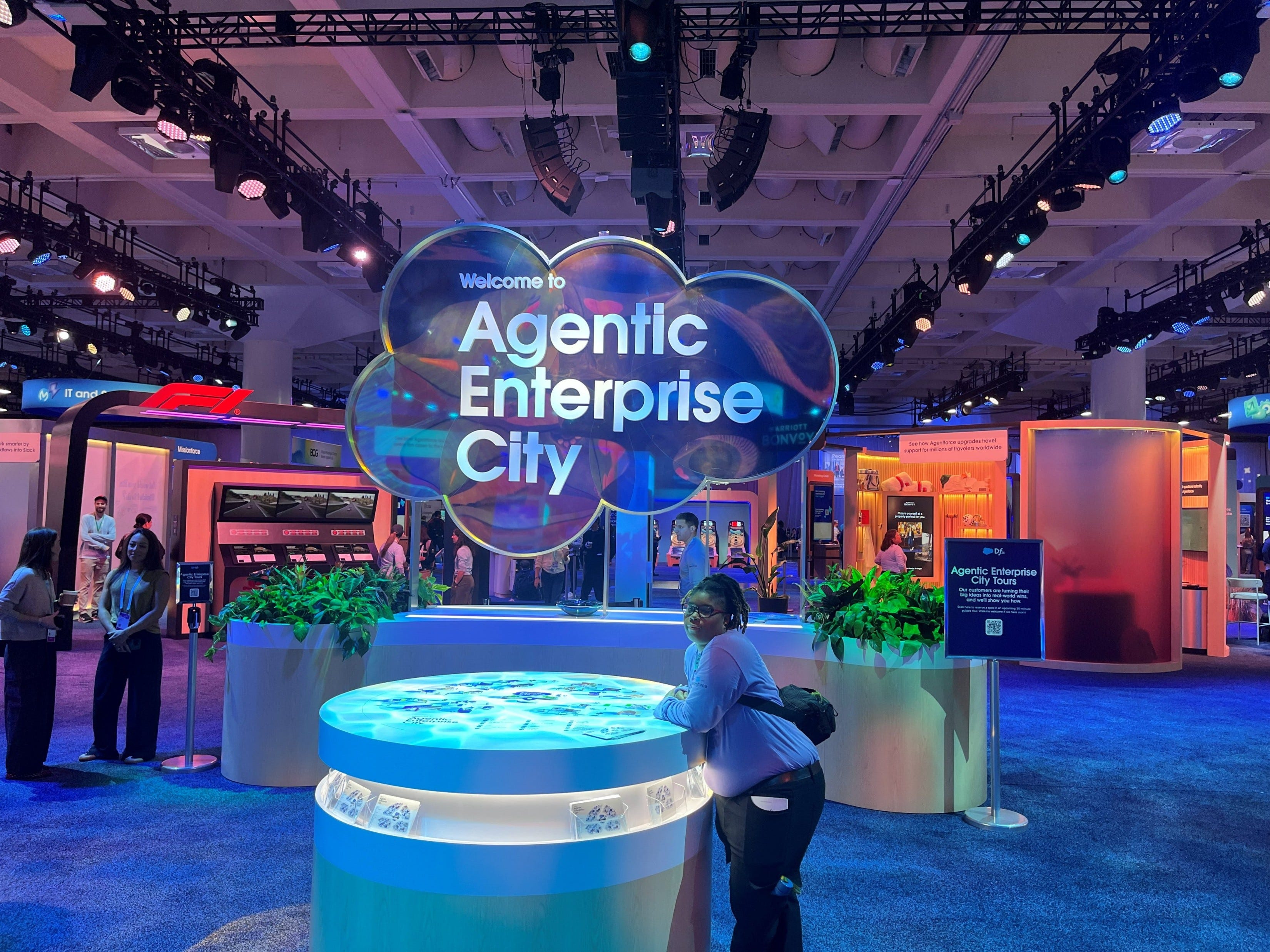
It is also beginning to demonstrate how the relationship between business intent and technology execution might change as enterprise platforms become increasingly headless. None of this is settled but nor should we expect it to be. It’s a crazy time and there is a lot to love if you embrace the chaos.
The implications extend well beyond Salesforce’s own products into the economics of its sales organisation, its partner ecosystem and the customers trying to make sense of what comes next. But there is a difference between a market that doesn’t have all the answers and one that isn’t making progress. And I think Salesforce deserves a lot of credit for the excellent and transparent progress it is making. The remaining challenge belongs just as much to customers.
It is becoming increasingly difficult to argue that the primary constraint on the Agentic Enterprise is simply the readiness of the technology or the trustworthiness of the vendors. Customers need to become clearer about how they want their organisations to work, what they are prepared to delegate to autonomous systems, how that work should be governed, and what successful execution should cost.
Because ultimately, the unit of value in the Agentic Enterprise isn’t the user, the token or even the agent. It’s the work itself and increasingly, how effectively businesses can organise themselves to get it done.
About Councilio
Councilio provides independent technology analysis, executive briefings, keynote speaking, workshops, and strategic consulting and advisory services.
Learn more: councilio.co