

I had a lot of conversations last month with regional MSP and ERP leaders. We largely spoke about all things AI, software and hyperscale platforms, general customer demand and the future of their respective industries. Much of the discussions covered ground that would be familiar to anyone working in technology right now. Data readiness is becoming more important. Customers are remaining trapped somewhere between AI workshops and production deployment. And automation, once considered yesterday's story, is quietly becoming fashionable again. None of that surprised me.
What did catch my attention though was the point at which, in conversation after conversation, with execs who had never spoken to one another, every discussion drifted into stories about their efforts to build intellectual property from the knowledge they have spent years accumulating.
This is not a new idea. The industry has long recognised the value of capturing knowledge and reusing it across future customers. Methodologies, accelerators, industry templates and centres of excellence all represent attempts to turn experience into something more durable than an individual project. We can see elements of this thinking in TechnologyOne's SaaS+ model, ServiceNow's implementation accelerators, Accenture's industry assets, IBM's industry frameworks, Infosys Topaz, Cognizant Neuro and countless other examples.
The challenge has never been recognising the opportunity. The challenge has been the cost and effort required to systematically capture, refine, maintain and scale that knowledge. As a result, much of the value created during customer engagements has remained trapped inside individuals, project teams and specific implementations. The opportunity has always existed. What is changing is the economics of realising it.
My recent conversations across the market increasingly point to two realities. First, most firms now recognise that they need to pivot (again) to solve this problem once and for all. Second, far fewer are clear on what they should pivot towards and are still searching for a sustainable source of competitive advantage. Those that are clear are increasingly focused on creating intellectual property. Products.
This is where the distinction becomes important. Many firms have spent years attempting to package expertise through methodologies, accelerators, frameworks, templates and more recently managed services and SaaS+ offerings. These approaches have undoubtedly improved delivery efficiency and helped organisations scale. But the product still exists to make the service more efficient. It does not yet replace the service as the primary vehicle for value creation. The underlying economics remain rooted in labour. What is emerging now is a model where expertise itself becomes the asset, and increasingly, the product.
So the next step is fundamentally different. Rather than simply making services easier to deliver, it seeks to transform expertise itself into a reusable asset. An asset that can be deployed, refined and scaled repeatedly without requiring a proportional increase in people, projects or delivery effort. Or cost to the customer. In that model, knowledge does not merely support the service. Increasingly, it becomes the product.
For much of the past thirty years, the managed services industry has operated according to the relatively simple formula of revenue as a function of people. More customers required more consultants. More projects required more project managers. More support contracts required more support staff. Growth was linear and predictable because delivery capacity was ultimately constrained by the number of people available to perform the work.
That model produced some extraordinarily successful businesses, but it also created a structural weakness whereby knowledge was constantly being generated, yet very little of it accumulated. Most of the value remained trapped inside people rather than becoming a durable asset of the delivery organisation. For years this was largely ignored because demand for technology services continued to grow. Today, however, financial markets are beginning to expose the limitation.
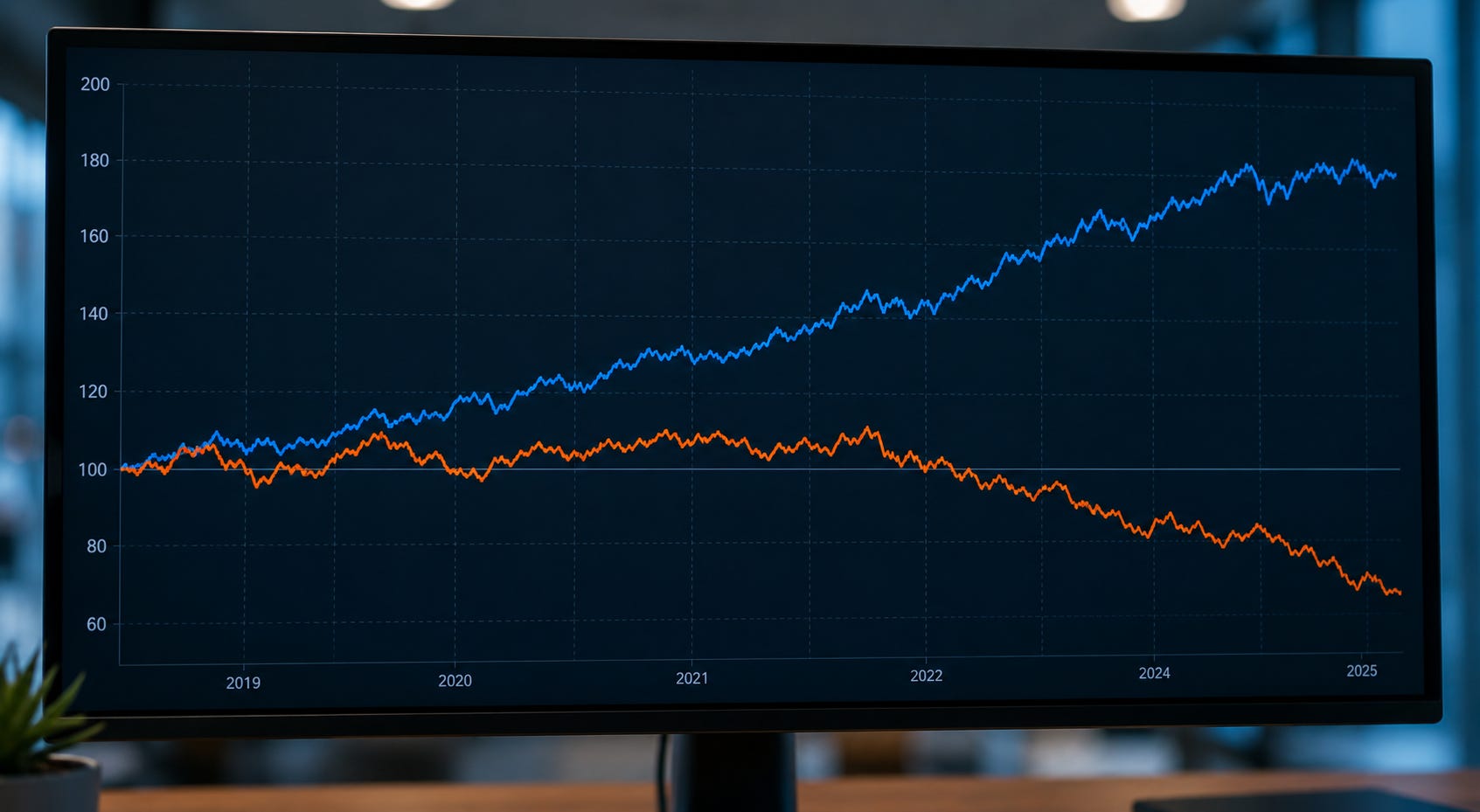
Across the NYSE, Nasdaq and India's major exchanges, investors are increasingly distinguishing between services businesses that scale through people and those that scale through intellectual property. The result is a growing valuation gap between organisations whose future depends primarily on hiring more staff or acquiring the next $10 million growth firm for functional or regional expansion, and those capable of systematically transforming expertise into reusable assets, software, automation and platforms. The shift is subtle but important. Growth is becoming less about accumulating capability and more about industrialising it. The firms creating the most value are increasingly those that can capture what they already know, refine it and apply it repeatedly at scale.
Lets’ look at a couple of common examples. A project team might solve a complex integration problem for a manufacturing client. Or a consultant would develop a highly effective process improvement approach for a council, state or federal government. Maybe a support engineer discovers a faster way to resolve recurring incidents. While the MSP organisation benefited from those experiences, it was often only indirectly because much of the expertise remained trapped within individuals and teams. Knowledge was constantly being generated, but much of its value walked out the door at the end of the day.
Most discussions about AI today still begin and end with labour. The focus on productivity, efficiency and headcount is understandable, but it is also causing us to overlook something far more significant. The more practical, and therefore interesting, question is what happens when contextual expertise becomes easier to package and reuse. What happens is that knowledge that previously disappeared at the end of a project can be transformed into IP that compounds over time. And that’s the lens through which MSPs will be judged. It means where the MSP of 2015 sold effort, the MSP leders of 2030 will sell accumulated specialised intelligence.
Evidence of this shift is already beginning to emerge. Recent moves by Coforge in the insurance sector demonstrate how technology service providers are increasingly combining domain expertise, proprietary intellectual property and AI capabilities into highly specialised industry offerings. The company is not positioning AI as a generic productivity tool. Instead, it is applying agentic AI directly to underwriting, claims management and insurance operations where years of accumulated industry knowledge create a genuine competitive advantage.
What connects examples like Coforge and other MSPs is not artificial intelligence itself. It is the recognition that expertise can be transformed into new informaiton assets. For decades, service providers primarily monetised knowledge through labour. They sold projects, consultants, developers and support teams. Increasingly, however, they are needing to find ways to monetise that same knowledge through software, workflows, automation, platforms and intellectual property. AI is not creating this trend but it is first unlocking and then accelerating it.
There is a reason it hasn’t happened before now. Historically, transforming expertise into a reusable asset required significant investment. Product development teams were expensive. Building software with the appropriate controls and governance often took years. Documentation was labour intensive and difficult to maintain. Capturing, refining and codifying organisational knowledge was not only slow and cumbersome, it was rarely the primary objective. It was simply a by-product of delivering projects and serving customers. In many cases, the effort required to formalise that knowledge worked against margins rather than enhancing them. As a result, much of the value remained embedded within people and projects instead of becoming a durable asset of the business itself. That is the friction that is now beginning to disappear.
A managed services provider that solves a problem once can increasingly convert that solution into something repeatable, whether that be through a reusable integration or turning an automation into a functional agent. By the time the tenth customer arrives, the organisation is no longer selling the same thing it sold to the first and what began as a consulting engagement has quietly evolved into intellectual property.
This is why the direction being taken by companies such as Coforge matter. Customers will not ultimately buy artificial intelligence but they will buy better underwriting, faster claims processing, improved risk assessment and more effective operational outcomes. So as artificial intelligence becomes ubiquitous, deep industry expertise will still be hard won, for now. Therefore as AI lowers the cost of creation, the value of specialised knowledge will only increase rather than diminish.
This may explain why some of the most successful managed services businesses are becoming increasingly specialised. They are not looking to narrow their horizons because they lack ambition. They are doing so because specialisation creates defensibility and while a competitor can easily replicate a technology, replicating twenty years of accumulated industry understanding is considerably harder.
One of the things this means is that the companies best positioned for the AI era may in fact be service providers that learn how to behave like software companies with vertical specialisations. Not by abandoning services or replacing people, but by transforming expertise into assets and amplifying the value of what their people know.
So overall I think the future of the managed services industry looks pretty strong, albeit confused as hell in 2026. The sector will evolve into something that sits somewhere between consulting, software and platform businesses. The winners will still employ talented people, and those people will still provide advice, and they will still solve difficult problems. The difference is that every problem solved will create another asset and every engagement will strengthen a growing bank of intellectual property. Those with strong PaaS partnerships will do better than those stuck in ERP land alone.
More importantly, that intellectual property will not be generic. It will increasingly reflect the accumulated experience of particular industries, customer segments and operational environments. The value will not come from building another workflow, integration or automation. It will come from building or deploying assets that embody years of hard-earned domain expertise.
We can already see this pattern emerging in other industries. Platforms such as Lovable are not simply automating web development. They are packaging decades of accumulated design, engineering and product development knowledge into a reusable asset that can be applied repeatedly across millions of projects. The customer is not really buying AI, nor an army of developers. They are consuming expertise through a different delivery model.
The same principle increasingly applies to MSPs. Over time, accumulated industry knowledge, delivery experience and operational understanding will behave less like labour and more like capital.
The conversations I’m having across the market increasingly point in the same direction. Most firms know they need to pivot and the ones that appear furthest along are building intellectual property. That means where the MSP or servies firm of 2015 sold effort, the MSP of 2030 will still sell expertise, but increasingly it will package, scale and monetise what it learns from the projects. That is step one.
The more difficult question is whether traditional services firms are equipped to make that transition. Because building a successful services business and building a successful product business require very different capabilities. One optimises for customer-specific outcomes. The other optimises for repeatability and scale. One rewards flexibility. The other rewards standardisation.
Every firm will ultimately embrace AI. It's just that some will use it to work faster inside the existing factory, while others will use it to rebuild the factory itself. Only one of those will make selling hours less important.
About Councilio
Councilio provides independent technology analysis, executive briefings, keynote speaking, workshops, and strategic advisory services.
Learn more: councilio.co